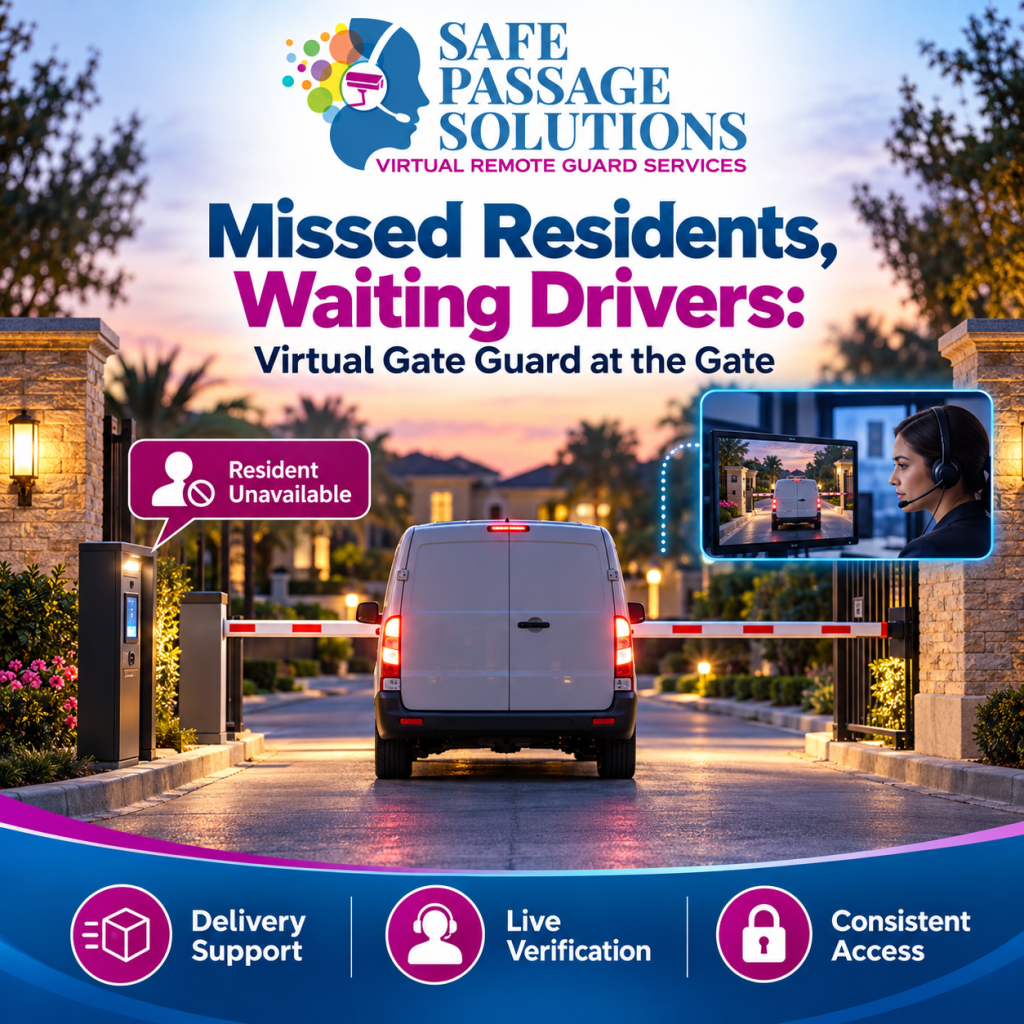
Missed Residents, Waiting Drivers: Virtual Gate Guard at the Gate
A delivery driver reaches the gate.
The driver has the correct address.
The resident receives a call or notification.
But the resident does not answer.
Now the driver waits.
Other vehicles may begin arriving behind them.
This simple scenario illustrates one of the challenges modern gated communities face:
How should the gate handle a legitimate delivery when the normal resident-response workflow stops?
Virtual Gate Guard can provide a live process for these situations.
Waiting at the Gate Can Become an Operational Problem
One delayed vehicle may not sound significant.
At a busy entrance, however, the delay can affect:
- Other delivery drivers
- Visitors
- Vendors
- Contractors
- Residents
- Traffic approaching the entrance
The Foundation for Community Association Research specifically warns that visitor telephone-entry systems can be time-consuming and that busy gated entrances require sufficient vehicle-stacking space to prevent visitor queues from blocking resident lanes or nearby roads. Community Association Research
Community Association Security Best Practices
Today's delivery volume makes that operational concern increasingly relevant.
Why Residents May Not Respond
A missed response does not necessarily mean the delivery is unexpected.
A resident may be:
- In a meeting
- Driving
- Away from the phone
- Taking care of a child
- Sleeping
- Working
- Experiencing a phone or notification problem
The gate still needs a defined next step.
Without one, the delivery driver may simply continue waiting or leave without completing the delivery.
Virtual Gate Guard Provides a Live Next Step
Virtual Gate Guard can provide remote communication when the normal access process requires additional interaction.
Depending on community-approved procedures, attendants may:
- Speak with the driver
- Confirm the stated destination
- Review available visitor or vendor records
- Check applicable access instructions
- Contact an approved party
- Follow established delivery procedures
- Escalate unresolved requests
This creates another path between:
resident does not answer
and
the access process stops completely.
The correct outcome still depends on the community's authorization rules.
Visitor Management Can Reduce Uncertainty
Visitor Management can provide information about an expected arrival before the driver reaches the gate.
For example:
- Destination
- Resident or unit
- Expected vendor
- Arrival period
- Access notes
- Approved contact
ASIS International defines access control as including the technology used to restrict access along with the policies and procedures supporting it. Its visitor-management research emphasizes the need to account for different visitor categories and access requirements. ASIS International
ASIS Visitor Management Guidance
For a gated residential community, delivery drivers represent another category that should have a clear process.
Pre-Registration Can Help, but It Will Not Solve Everything
Properties may encourage residents to pre-register expected service providers or deliveries when appropriate.
That can make access more predictable.
However, not every delivery can be planned in advance.
Examples include:
- Replacement drivers
- Changed delivery windows
- Same-day food orders
- Grocery services
- Unplanned courier deliveries
- Medical deliveries
That is why the community still needs an exception process.
Give Each Arrival Type a Clear Path
| Arrival | Possible Workflow |
|---|---|
| Expected visitor | Visitor Management record |
| Routine delivery with approved procedure | Established delivery workflow |
| Resident unavailable | Virtual Gate Guard interaction |
| Delivery information differs | Review and exception procedure |
| Authorization confirmed | Follow approved access instructions |
| Authorization remains unresolved | Escalation or property-defined outcome |
The value comes from knowing the next step before the problem occurs.
Virtual Gate Guard Does Not Replace Authorization
Live communication does not mean the remote attendant independently decides that every delivery is legitimate.
The community establishes:
- Who may authorize access
- What information must be available
- Which deliveries qualify for specific procedures
- What happens after hours
- When another contact should be used
- When the request should be escalated
Virtual Gate Guard can then apply those approved procedures consistently.
Think Beyond Food and Packages
Delivery access can include much more than restaurant orders.
Communities may encounter:
- Amazon or parcel carriers
- Grocery services
- Pharmacy deliveries
- Medical supplies
- Furniture deliveries
- Florists
- Meal services
- Courier services
- Maintenance supplies
Some deliveries may be more time-sensitive than others.
A property can account for those differences within its procedures without assuming that every delivery receives automatic access.
CISA's facility-access guidance emphasizes establishing procedures for visitors and authorized access based on operational requirements. Although its guidance is intended for federal facilities, the broader idea is applicable: different visitor categories should have defined handling procedures rather than ad hoc decisions at the entrance. CISA
CISA Facility Access Control Best Practice
Frequently Asked Questions
Why do delivery drivers get stuck at gated communities?
One common reason is that the access process depends on a resident responding to a call, notification, or entry request.
Can Virtual Gate Guard help when the resident does not answer?
Virtual Gate Guard can provide live communication and follow the community's approved procedures for that situation.
Does that mean the delivery driver automatically enters?
No. Access still depends on the property's authorization and exception rules.
Can delivery information be entered before the driver arrives?
Depending on the community's Visitor Management setup, expected visitor or vendor information may be recorded before arrival.
What if the delivery cannot be verified?
The request should follow the community's escalation or unresolved-access procedure.
Key Takeaways
- A missed resident response can leave delivery drivers waiting at the gate.
- One delayed vehicle can contribute to gate congestion.
- Virtual Gate Guard can provide a live next step when the normal workflow stops.
- Visitor Management can reduce uncertainty for expected arrivals.
- Not every delivery can be pre-registered.
- Communities should define what happens when resident confirmation is unavailable.
- Virtual Gate Guard supports the property's procedures rather than replacing its authorization rules.
Final Thoughts
The delivery challenge at gated communities is not simply about opening the gate faster.
It is about having a clear process when the expected authorization step does not happen.
Resident responds → normal process
Resident does not respond → defined exception process
Virtual Gate Guard can provide the live communication needed during that second scenario.
That can help communities create a more consistent gate experience for residents, delivery drivers, and property management teams without removing the authorization rules that govern access.
Safe Passage Solutions can help communities evaluate how Virtual Remote Guard, Visitor Management, License Plate Recognition and RFID Access Control may fit into a more organized delivery-access strategy.
Author
safesolutionLearn how Virtual Gate Guard improves the delivery process for gated communities, ensuring smoother traffic flow and reduced waiting times.