What Happens When an After-Hours Vendor Needs Access to Your Community?
Author
safesolutionWhat Happens When an After-Hours Vendor Needs Access to Your Community?
A vendor arriving after hours can create an immediate access decision.
The gate office may be closed. On-site personnel may be unavailable. Meanwhile, the property manager may not be able to respond immediately.
At the same time, the vendor may be waiting to complete an important service.
For HOA boards and property managers, these situations require more than a quick decision.
They require a clear after-hours vendor access process.
A well-organized process can help communities determine how scheduled vendors, recurring contractors, emergency technicians, and unexpected service providers should be handled.
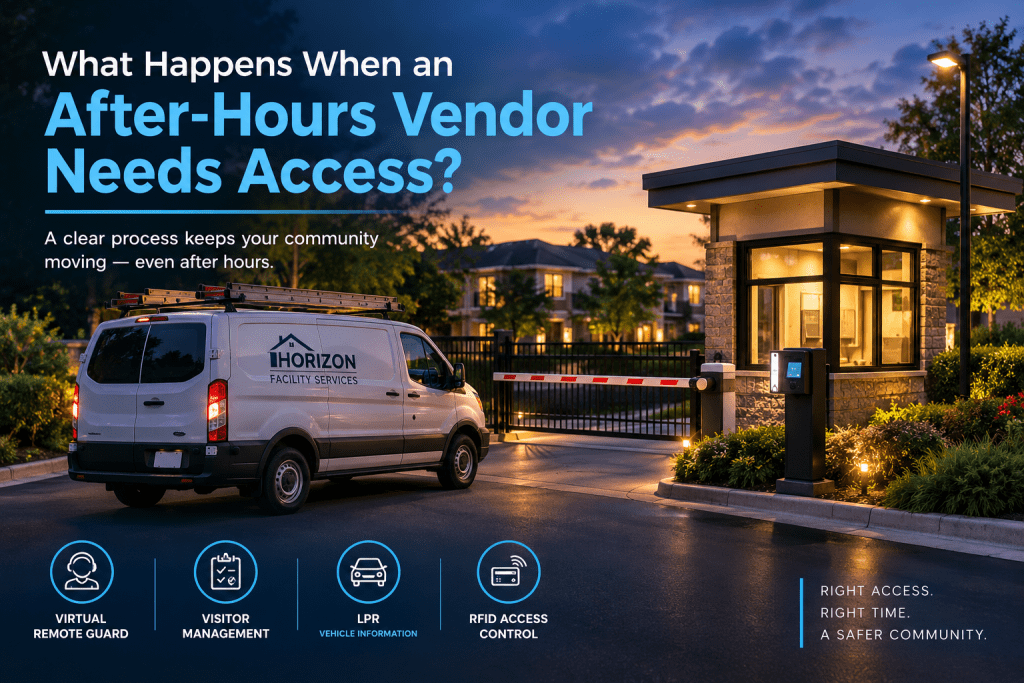
After-Hours Vendor Access Can Affect Property Operations
Vendor access can play an important role in daily property operations.
For example, a technician may arrive to repair equipment. A contractor may need to complete scheduled work. Similarly, a service provider may respond to a maintenance issue outside normal business hours.
If the vendor cannot enter when appropriate, the work may be delayed.
As a result, residents, property staff, and scheduled operations may all be affected.
However, faster access should not replace proper verification.
Instead, the goal should be to manage legitimate after-hours vendor access efficiently while continuing to follow the community's established procedures.
Start by Identifying the Type of Vendor
Not every vendor should follow the same access process.
A gated community may receive several types of after-hours service requests, including:
- Scheduled contractors
- Recurring maintenance providers
- Emergency repair technicians
- Utility service providers
- Cleaning companies
- Landscaping providers
- Specialized service technicians
The type of visit can help determine what information needs to be reviewed.
For instance, a recurring vendor may already be familiar to the property and have an established access process. On the other hand, an emergency technician may require additional confirmation before access is granted.
Likewise, an unexpected person claiming to be a vendor may require further verification.
A clear process helps the gate operation respond consistently to each situation.
Scheduled Vendor Access Should Begin Before Arrival
A strong after-hours access process begins before the vendor reaches the community.
Property teams can communicate important information in advance.
This information may include:
- Scheduled date
- Expected arrival time
- Vendor company name
- Technician or employee information
- Purpose of the visit
- Authorized contact
- Property or unit location
- Approved access instructions
Visitor Management can help organize expected vendor and temporary visitor information.
Depending on the property's system and procedures, this information may be available before the service provider arrives.
As a result, gate personnel or remote attendants may spend less time gathering basic information at the entrance.
What Information Should Be Available at the Gate?
Gate personnel or remote attendants need enough information to follow approved procedures.
The exact information will depend on the property's policies. However, communities may consider whether they can confirm:
- Who is requesting access
- Why they are visiting
- Whether the visit is expected
- Who authorized the visit
- What area requires access
- Whether additional confirmation is needed
Having this information available can support a more consistent access process.
It can also reduce unnecessary communication when a vendor arrives outside normal office hours.
Virtual Remote Guard Can Help Manage After-Hours Requests
A Virtual Remote Guard can provide live remote communication for selected after-hours access situations.
Safe Passage Solutions remote attendants can communicate with arriving vendors through compatible gate technology. They can then follow the property's approved procedures when handling the request.
Depending on the property's setup and policies, remote support may assist with:
- Communicating with vendors
- Reviewing available visitor information
- Managing approved access requests
- Handling contractor arrivals
- Providing after-hours communication
- Following established verification procedures
This gives communities another option when on-site personnel are unavailable.
In addition, Virtual Remote Guard support can help provide a live point of communication without requiring property staff to personally handle every after-hours request.
LPR Can Provide Additional Vehicle Context
A vehicle can provide useful information during an access request.
License Plate Recognition (LPR) can capture license plate information at designated entry points.
This may provide additional context for the gate operation.
For example, available vehicle information may relate to:
- Recurring vendor vehicles
- Contractor vehicles
- Resident vehicles
- Guest vehicles
- Delivery vehicles
- Service vehicles
However, LPR should be part of a larger access process.
Vehicle information alone should not replace proper authorization.
Instead, LPR can provide another source of information while gate personnel or remote attendants follow established property procedures.
RFID Can Support Recurring Vendors
Some vendors need repeated access to the same community.
For example, a maintenance company may service the property regularly. Likewise, a cleaning provider may arrive during scheduled evening hours.
Depending on the property's policies, RFID Access Control can provide electronic credentials for approved recurring users at compatible access points.
This can create a more efficient process for regular access.
At the same time, temporary or unexpected vendors can continue through the appropriate verification process.
Property teams can also manage credentials as vendor relationships, schedules, or access requirements change.
A Realistic After-Hours Vendor Access Scenario
Imagine a gated community experiencing an equipment issue during the evening.
Property management schedules a technician to arrive after normal office hours.
The technician reaches the gate.
Fortunately, the community has an established after-hours vendor access process.
The vendor's information was organized before arrival through Visitor Management. LPR captures vehicle information at the designated entrance. Meanwhile, a Virtual Remote Guard communicates with the technician.
The remote attendant reviews the available information and follows the property's approved access procedures.
The request is then handled according to the available authorization and community policies.
The process is organized because the property planned for the situation before it occurred.
What Happens When Vendor Information Is Missing?
Information may not always be available.
For example, a vendor may arrive without a record of the appointment. The technician's name may differ from the original schedule. In some cases, the company may send a replacement employee.
When this happens, the property should have a clear escalation process.
Additional verification may be required. An authorized property contact may need to be involved. Alternatively, the request may need to follow another approved procedure.
The important point is consistency.
The gate operation should not rely on assumptions when important information is missing.
Instead, personnel should know what steps to follow and when the request needs additional review.
Signs Your After-Hours Vendor Access Process Needs Attention
Consider reviewing the current process if your community regularly experiences:
- Vendors waiting outside the gate
- Repeated after-hours phone calls
- Unanswered authorization requests
- Confusion about scheduled work
- Contractors arriving with incomplete information
- Property managers handling frequent late-night access issues
- Delayed maintenance or repair work
- Gate personnel spending too much time verifying vendors
- Difficulty tracking temporary access
- Inconsistent procedures for unexpected service providers
One isolated issue may not indicate a larger problem.
However, repeated situations can suggest that the current process needs clearer procedures or additional support.
Benefits of a Planned Vendor Access Operation
| Access Need | Potential Support |
|---|---|
| Expected vendor information | Visitor Management |
| After-hours communication | Virtual Remote Guard |
| Vehicle context | LPR |
| Recurring vendor entry | RFID Access Control |
| Missing information | Clear escalation procedures |
| Limited staff availability | Remote access support |
| Operational consistency | Established access policies |
| Vendor verification | Organized information and procedures |
Frequently Asked Questions
Why is after-hours vendor access important?
Vendors may need to perform scheduled maintenance, emergency repairs, or other services outside normal office hours. Therefore, a clear process can help communities manage legitimate requests without relying on last-minute decisions.
What is the best way to manage scheduled vendors?
The property should establish clear procedures and organize relevant vendor information before arrival. Depending on the property's system and policies, Visitor Management may help support this process.
Can a Virtual Remote Guard handle after-hours vendor communication?
Yes. Depending on the property's technology and procedures, a Virtual Remote Guard can communicate with vendors and follow approved access processes for selected after-hours requests.
How does LPR help with vendor access?
LPR can provide additional vehicle information at designated access points. However, it should complement rather than replace the property's authorization procedures.
Can recurring vendors receive RFID credentials?
Depending on property policies and compatible access points, RFID credentials can support approved recurring users who require regular access.
What happens if the vendor's information does not match the scheduled visit?
The property should follow its established escalation and verification procedures. Depending on the situation, additional confirmation may be required before the access request is handled.
Key Takeaways
After-hours vendor access requires preparation.
Scheduled vendors and unexpected service providers may require different verification procedures.
Therefore, communities should establish clear processes before an after-hours request occurs.
Visitor Management can help organize expected vendor information before arrival.
Virtual Remote Guard can provide live remote communication for selected after-hours access situations.
LPR can provide additional vehicle information at designated entrances.
RFID Access Control can support authorized recurring users at compatible entry points.
Most importantly, clear procedures can help communities manage after-hours vendor access more consistently.
Final Thoughts
A vendor arriving after hours should not force property teams to make an unplanned decision.
Instead, the community should already know what information is needed, who is responsible for communication, and how the request should be handled.
A clear after-hours vendor access process can help reduce unnecessary delays while maintaining established access procedures.
Safe Passage Solutions can help properties evaluate how Virtual Remote Guard, Visitor Management, LPR, and RFID Access Control can work together based on their individual operational needs.